
Cash Flow Dashboard
1. The headline numbers
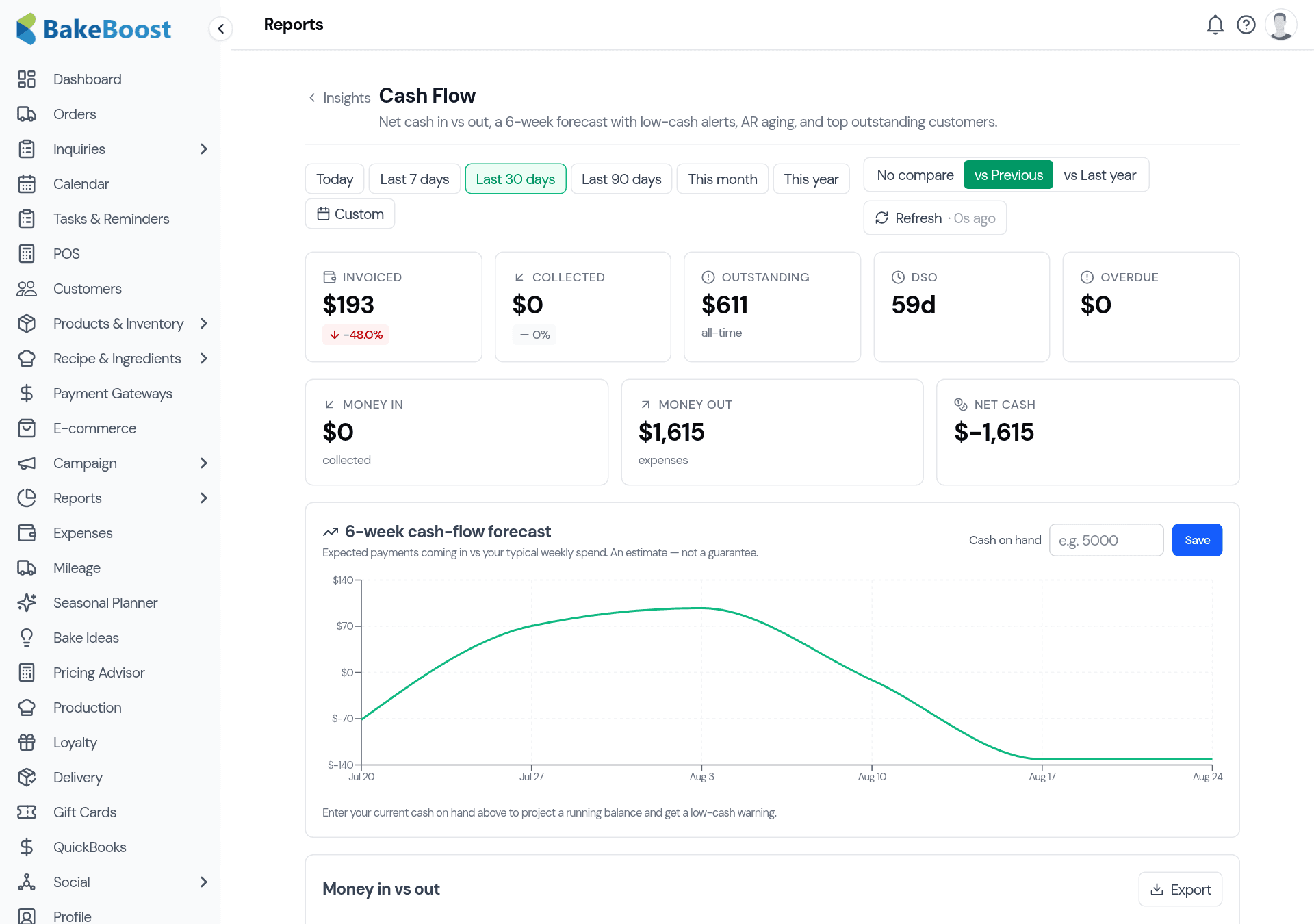
Along the top, a set of cards give you the state of play for the period you pick:
- Invoiced — the value you've billed.
- Collected — what customers have actually paid.
- Outstanding — money still owed to you across all open orders.
- DSO (days sales outstanding) — how long, on average, customers take to pay.
- Overdue — the part of what's owed that's now late.
Below them, Money in, Money out and Net cash tell you whether more came in than went out over the period.
Use the date buttons (Last 7 / 30 / 90 days, this month, this year, or a custom range) and the compare option to see how a period stacks up against the last one.
2. The six-week forecast
The chart projects your balance six weeks ahead, based on the payments you're expecting in and your typical spending going out. Enter your cash on hand — what's in the bank right now — and the forecast lines up from there, so you can see the weeks where things might get tight before they do.
3. Who owes you
Cash flow problems are usually just unpaid invoices. The dashboard breaks down your receivables — how much is outstanding, how overdue it is (the AR aging), and your top outstanding customers — so you know exactly who to chase first to bring cash in.
4. Money in vs out
Lower down, Money in vs out charts your collections against your spending over time, so you can see the rhythm of your business — the busy weeks, the quiet ones, and whether the trend is heading the right way.
Good to know
- Cash flow isn't profit. This view tracks money moving, not sales on paper — the gap between the two is usually money customers still owe you.
- Enter your cash on hand for the forecast to be meaningful — it's the starting point the projection builds from.
- Watch the low-cash alert. It's an early warning, not an after-the-fact report.
- Chase by aging. The outstanding-customers and overdue breakdowns tell you who to follow up first.
- It's a Pro feature. Cash Flow lives in Reports → Insights; see the Reports and Insights guide for the rest of the dashboards.
Last updated July 24, 2026