
How much should I charge for a cake?
1. Know what the cake actually costs you
You can't price a cake until you know what it costs to make. In Bake Boost, that starts with your recipes.
- Add your ingredients with what you pay for them, then build your recipes from those ingredients. Bake Boost works out the cost per serving (or per gram, or per piece) automatically.
- Don't forget your packaging and supplies — boxes, boards, ribbon, dowels. They add up, and they're part of the cost.
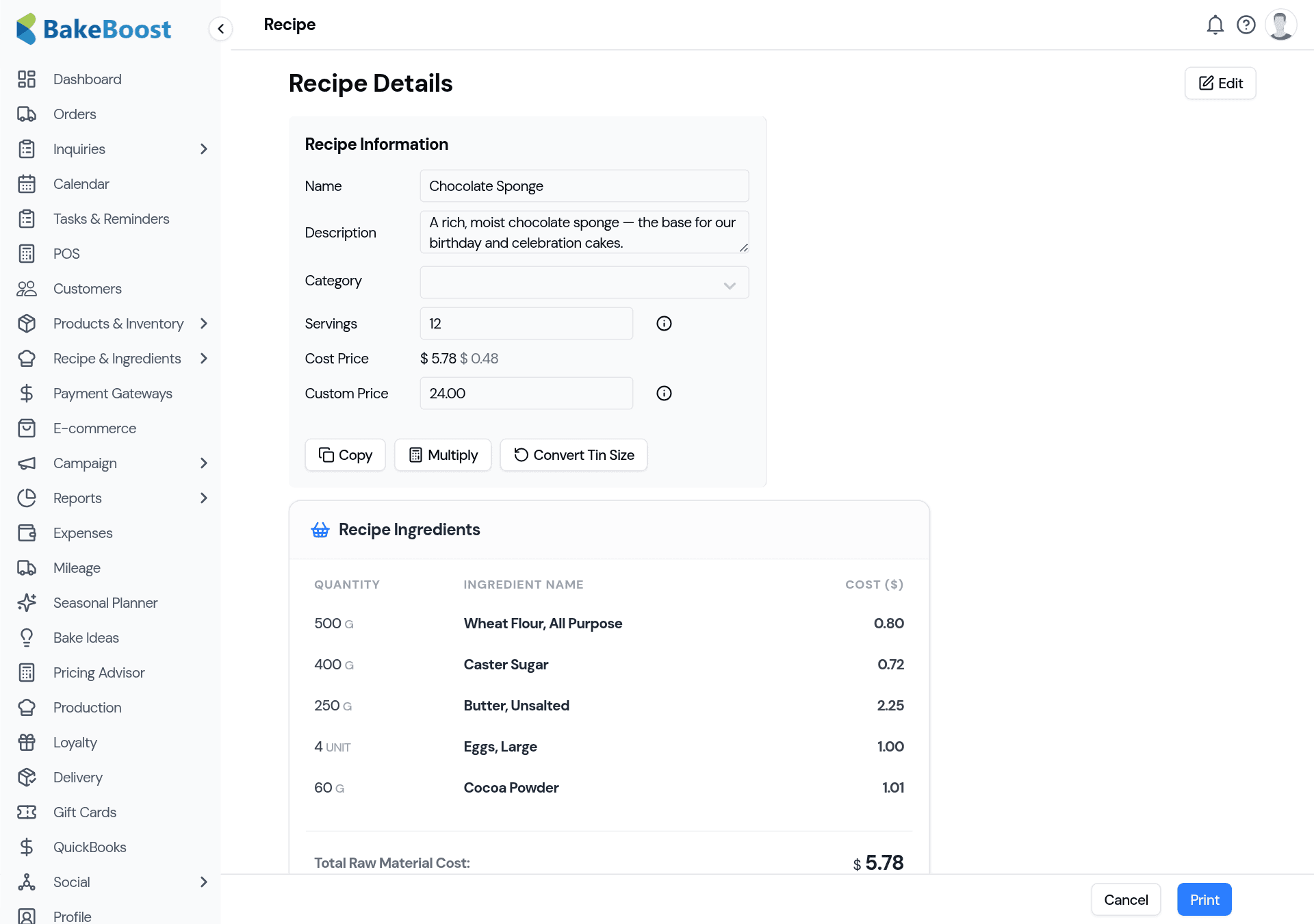
See Recipes, ingredients and supplies for the full walkthrough.
2. Add your time — it's not free
The mistake almost every new baker makes is pricing only the ingredients. A cake that costs £8 in ingredients but takes you four hours to decorate is not an £8 cake.
- Decide on an hourly rate for your labour and be honest about how long a cake really takes — baking, decorating, and the cleanup.
- Add a share of your overheads — electricity, rent, insurance, the tools that wear out. These are real costs even when they don't show up in a recipe.
3. Work out how many it serves
For tiered and larger cakes, price is often driven by how many people it feeds. Use the built-in Cake Servings guide to get an accurate serving count for any size, shape and portion style — then you can think in terms of a price per serving, which is how most custom-cake pricing works.
4. Set your price with a markup
Once Bake Boost knows a product's cost, you add a markup to reach your selling price — a fixed amount or a percentage on top of cost. A common starting point for baked goods is a food-cost of around 25–35% (i.e. selling at roughly 3–4× your ingredient cost), but your right number depends on your market and how much hand-work goes in.
Set the markup on the product form; Bake Boost fills in the retail price. See Products and your catalogue.
5. Let the AI Pricing Advisor sanity-check it
If you're not sure, the AI Pricing Advisor (a Pro feature) suggests a price range worked out from that product's real cost, your labour, and what you've actually charged before — with a plain-English reason.
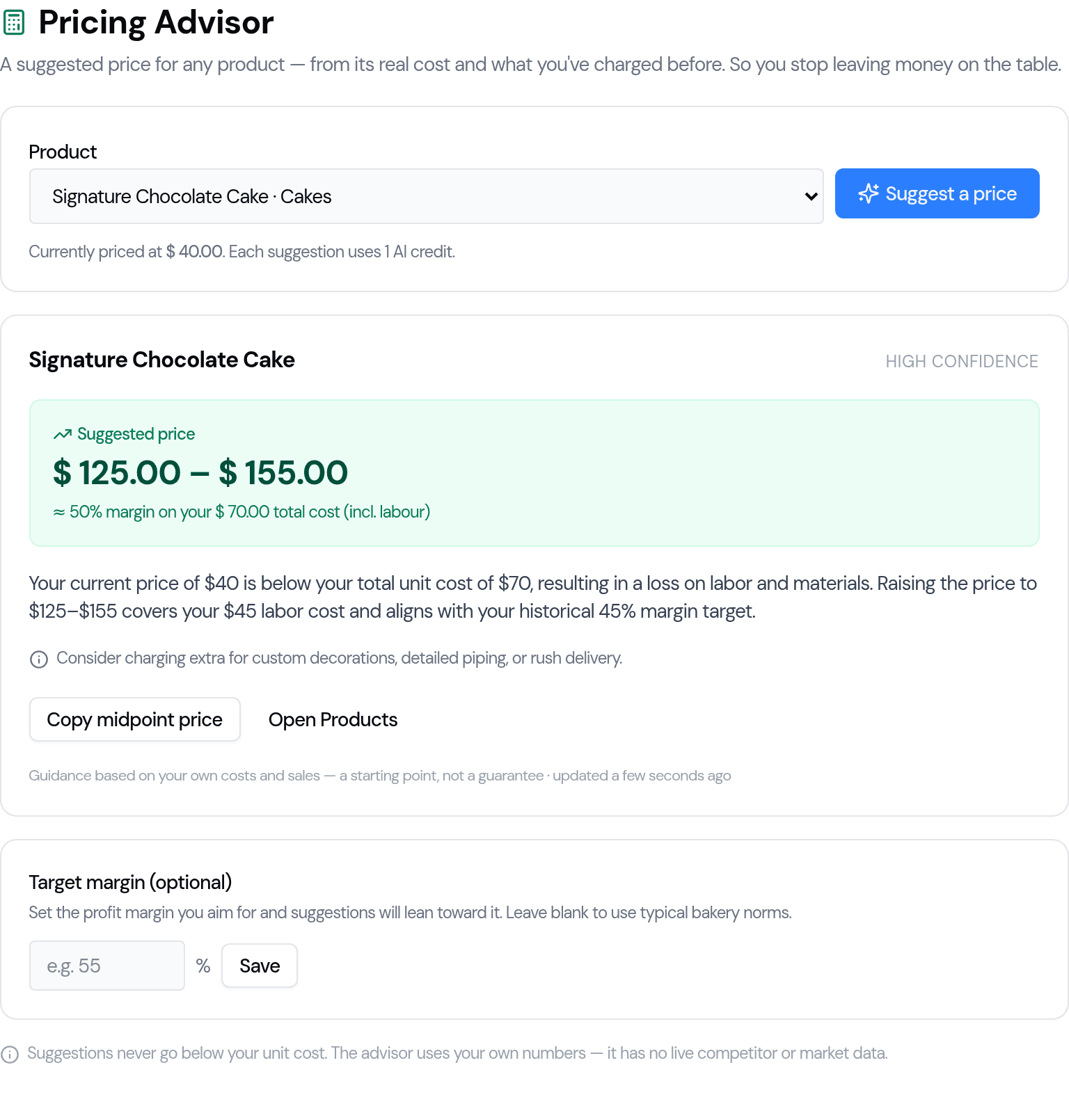
You can also click ✨ AI suggest a price right on the product form and apply the suggestion in one tap.
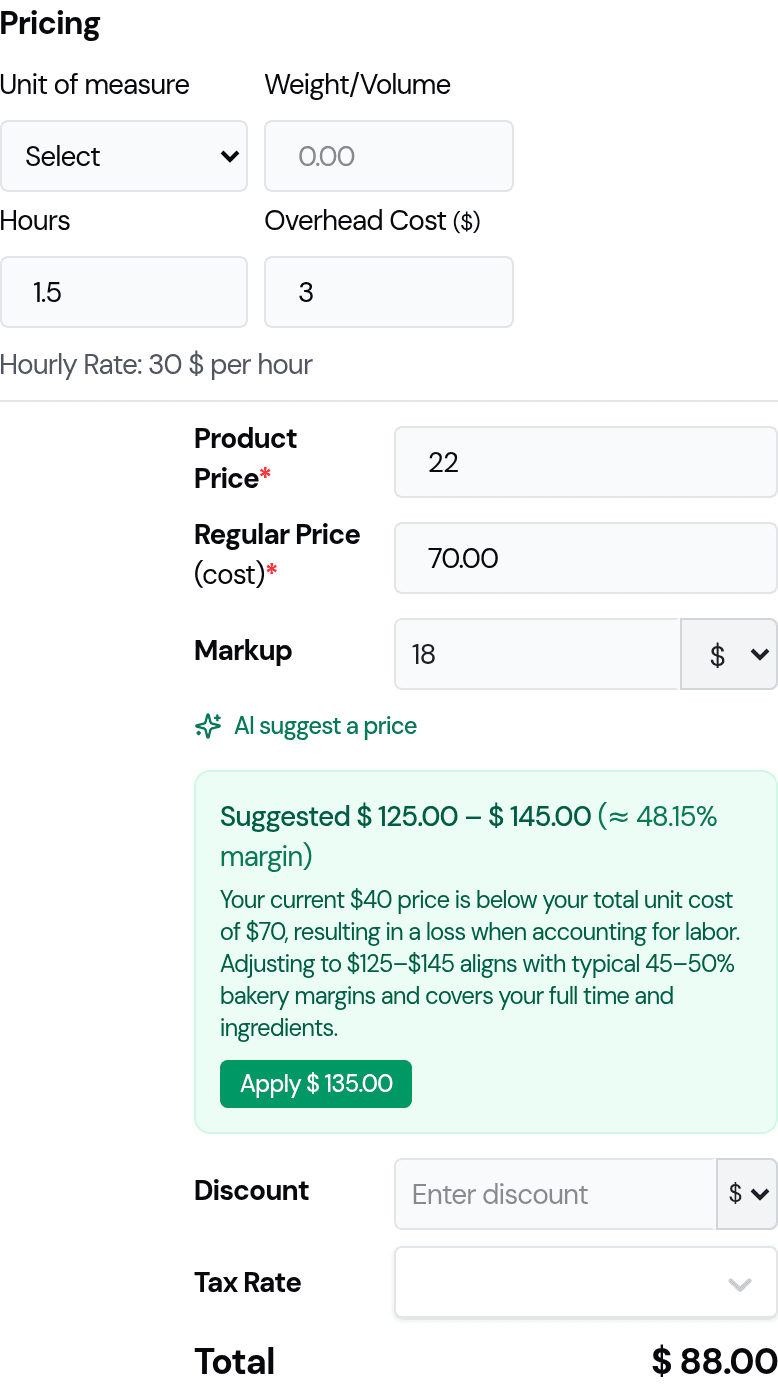
See AI Pricing Advisor for how it works.
A worked example
A single-tier 8″ celebration cake:
- Ingredients + box/board: £9
- Your time: 2.5 hours at £15/hour = £37.50
- Overheads share: £3.50
- Total cost: £50
- Add a margin so you're actually making money → price around £85–£95
Notice how the ingredients were the smallest part. That's normal for custom cakes — you are selling skill and time, not flour.
Good to know
- Cover cost, time and overheads — then add profit. A price that only covers ingredients is a loss.
- Charge for your hours. Decorating time is the biggest hidden cost.
- Think per serving for big cakes. The servings guide turns size into a number you can price against.
- Let the AI Advisor check you. It grounds a suggestion in your real cost and history.
- Review your prices as costs rise. Re-cost your recipes when ingredient prices change.
Related questions
- How do I price a cake for profit?
- Add up your ingredients, your decorating time at an hourly rate, and a share of overheads to get your true cost — then add a margin on top. A price that only covers ingredients loses money.
- How much should I charge per serving for a cake?
- Work out your cost per serving, then set a per-serving price that leaves a healthy margin — many bakers aim for ingredients being 25–35% of the price. Use the Servings guide to get an accurate serving count first.
- Why are my cakes not making money?
- Usually because the price only covers ingredients, not the hours of decorating. Charge for your time and overheads too, and re-cost your recipes whenever ingredient prices rise.
Last updated August 4, 2026